
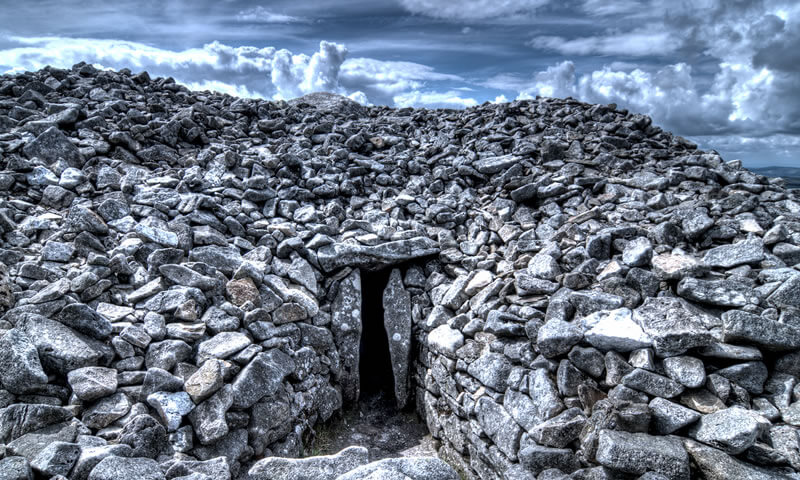
From Kippure Estate let us follow in the footsteps of our ancient ancestors from the Stone Age to the Iron Age – their druids, the warrior division of the Iron Age Fianna, on to the top of magical SeefinMountain. There, after a 1.5 hour walk, you will discover the 5000 year old Seefin megalithic tomb or passage grave. The nearby hills of Seefingan and Seahan also have pre-historic unopened cairns on their peaks. It is said that on a clear day you can see the world renowned passage grave at Newgrange in Co. Meath and that Seefin was deliberately built to be seen from Newgrange. In many ways Seefin tumulus is as interesting as Newgrange (3 internal alcoves), Seefin has 5 alcoves. When you reach Seefin peak you are standing on blanket peat – without a stone or rock in sight. Yet this tumulus on the 620m mountain is 3m high and 25m long and built of stone. Where did the stones come from? Did our ancestors carry up all these stones from the countryside 320m below? Is there some other explanation?
Seefin may have got its name from Fionn Mac Cumhaill, the warrior leader of the Leinster Fianna who roamed this way about 300AD. Seefin may mean the seat of Fionn. The exploits of the Fianna were recorded in writing in the monasteries about 600 AD – these recordings were known as the tales of the Fiannachta.
Oisín, Niamh Cinn Óir and Tír na nÓg
The Fiannachta tales records that Fionn had a son called Oisín. One day Oisín was standing beside the Irish Sea at Wicklow with his band of warriors. They saw a white horse trotting over the waves ridden by a beautiful youthful maiden with golden waist-length hair. She rode her horse up to the band of Fianna and Oisín asked her who she was. She answered that her name was Niamh Cinn Óir (Niamh of the golden hair) from Tír na nÓg, the land of eternal youth over the sea. Oisín then asked Niamh could he visit her land of Eternal Youth. She answered ‘jump up behind me on my white steed’. Oisín considered the offer for a while. He then said good bye to his companions and jumped up on the horse behind Naimh and away they sped over the waves.
The Death of Oisín – The Oisín Stone Saga in Gleann na Smól
Oisín was received by all in the beautiful land of young people, Tír na nÓg. After a certain amount of time Oisín felt lonely and told Niamh that he would like to pay a visit back home. She said ‘yes you can have my horse but remember you cannot set foot on the ground because if you do you will immediately become a very old man, because it is 300 years in Fianna time since you left your friends’. Oisín said ‘it will only be a short visit. I will not get off my horse and will be back very soon to this wonderful land of eternal youth’. Oisín set off trotting over the waves until he came to Ireland (Wicklow). He continued on to the old Fianna ‘stomping ground’ around the present city of Dublin. Oisín came to a valley below Seefin/Seefingan Mountains which was and is called Gleann-na-Smól (near modern Tallaght). In the Glen he came across a group of up to a dozen men (very small to him) trying to lift a big rock out of the ground. Oisín looked on at all their efforts and he went over to them and said ‘in my day we, the Fianna, each of us could lift the rock on his own. He then lent over the side of his horse and lifted up the rock – but as he did so the saddle girth broke and he fell to the ground. Immediately, in front of their eyes, the men saw this big strong man become an old withered man unable to get up. St Patrick was nearby and came and heard Oisín’s confession and baptised him. Oisín died in his arms and went to heaven.